
If you run a business as a sole proprietor, money probably moves through your accounts every month in a familiar order. Your clients pay you. You pay your business expenses. Then you use what’s left for your household and mortgage.
That order is worth examining.
Cash damming changes how you fund expenses you already have. You direct available business receipts toward your personal mortgage, then use properly structured borrowing to pay suitable business costs. When the borrowing qualifies, its interest may be deductible.
To understand the mechanics, let’s look at an illustrative $500,000 mortgage and a $5,000 monthly cash flow example, including the potential benefits, the limitations, and what you need to check before putting the strategy into practice.
What happens to the money each month
Start with $5,000 of business receipts that can genuinely be committed to the strategy after protecting your tax obligations, household needs, and operating buffer. The example also assumes $5,000 of suitable business payments need funding that month.
You apply the receipts as an additional principal payment on your home mortgage. You then borrow $5,000 through the approved lending structure and use those borrowed funds for the business payments.
The cash has done two jobs in sequence. Your existing money has reduced personal mortgage principal. Replacement borrowing has funded the business.
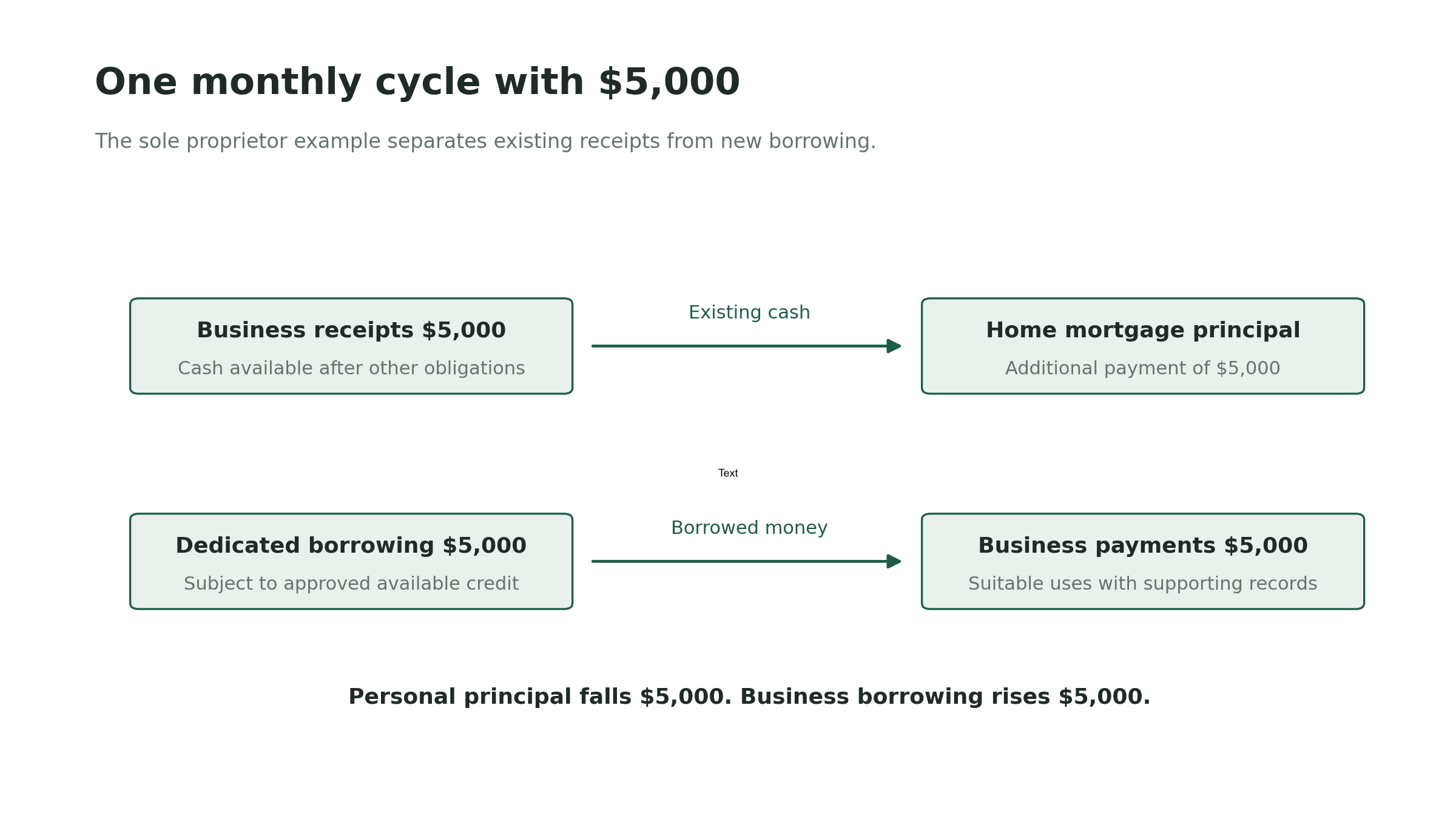
Figure 1. The $5,000 matched principal shift from Article 1. Funding capacity must be confirmed before receipts are committed.
After one matched $5,000 cycle, your personal mortgage principal is $5,000 lower and your business borrowing is $5,000 higher, before regular payments, interest, and fees.
That transfer has not erased $5,000 of household debt. It has changed the use associated with that portion of borrowing.
This is why account setup matters. CRA describes cash damming as separating borrowed money from other funds to help trace its use. A dedicated borrowing account and a payment record make the transaction easier to follow. They do not make every payment eligible.
Why the business use matters
Your home can secure a loan used for your business. That does not make the loan personal for tax purposes. Equally, putting a personal purchase on a business-labelled account does not make its interest deductible.
The Income Tax Act sets conditions for deducting interest, including an income-earning use of borrowed money, a legal obligation to pay interest, and a reasonable amount. Your accountant needs to assess the actual transactions against those conditions.
For this example, that means reviewing which business costs can be funded, retaining invoices, and connecting each payment to its borrowing.
Your ordinary expense claim and the interest claim are separate questions. Borrowing does not create a second deduction for the original invoice.
CRA’s business guidance also identifies restrictions on interest claims, including borrowing for personal purposes. The business name on an account does not override those restrictions.
This article assumes you operate personally as a sole proprietor. If your revenue belongs to a corporation, get advice on the corporate and shareholder transactions before using it toward your home. Do not treat corporate receipts as personal cash available for this cycle. CRA identifies a corporation as a separate legal entity.
Comparing the borrowing costs
Consider a 4% personal mortgage rate, a 4.95% business borrowing rate, and an assumed 44% marginal tax rate.
If the full interest deduction is available at that assumed tax rate, the simplified after-tax borrowing cost is:
4.95% × (1 − 44%) = 2.772%
Here is how that compares on an unchanged $100,000 balance:
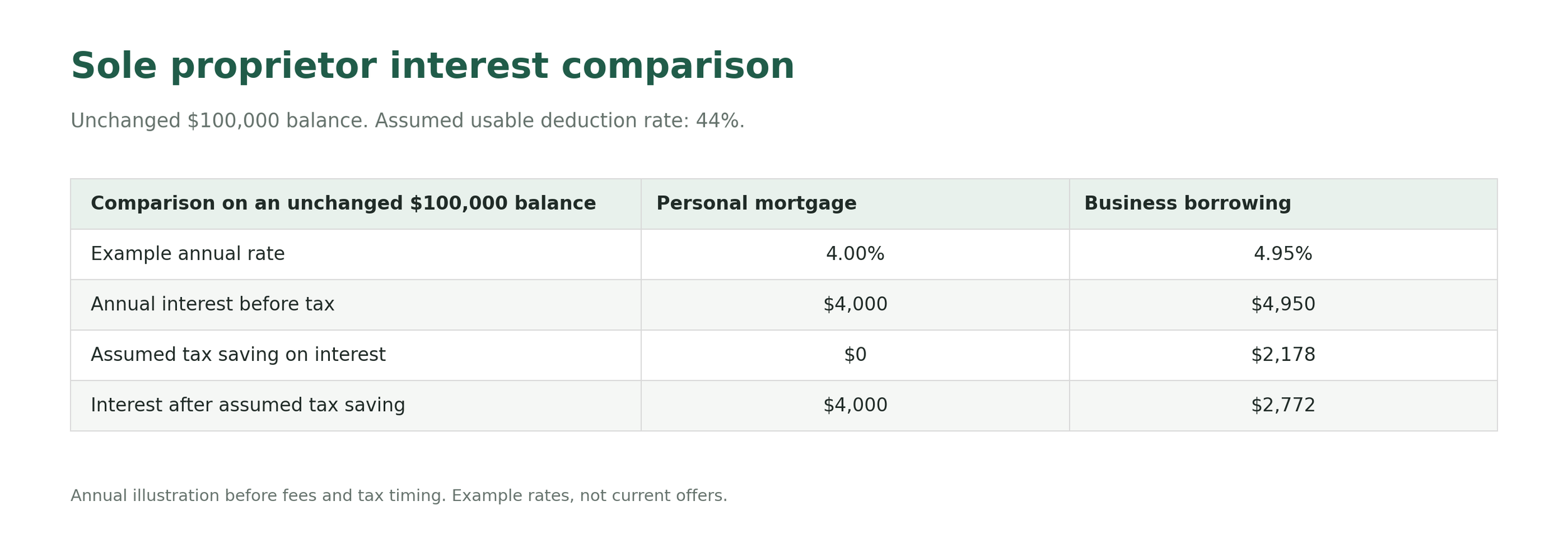
The resulting difference is $1,228 a year per $100,000 of unchanged principal, before fees.
That is a comparison of borrowing costs, not the lifetime result of the whole strategy.
You still need to pay the lender’s full interest charge when due. A tax deduction reduces taxable income. Its cash benefit depends on your tax position and timing; it is not a monthly discount automatically applied by the bank.
What if the borrowing rate rises
Suppose the borrowing rate increases five times by 0.25 percentage points. That takes it from 4.95% to 6.20%.
At the same assumed 44% deduction rate, the simplified after-tax cost becomes:
6.20% × (1 − 44%) = 3.472%
The difference against the example’s 4% mortgage falls from 1.228 to 0.528 percentage points.
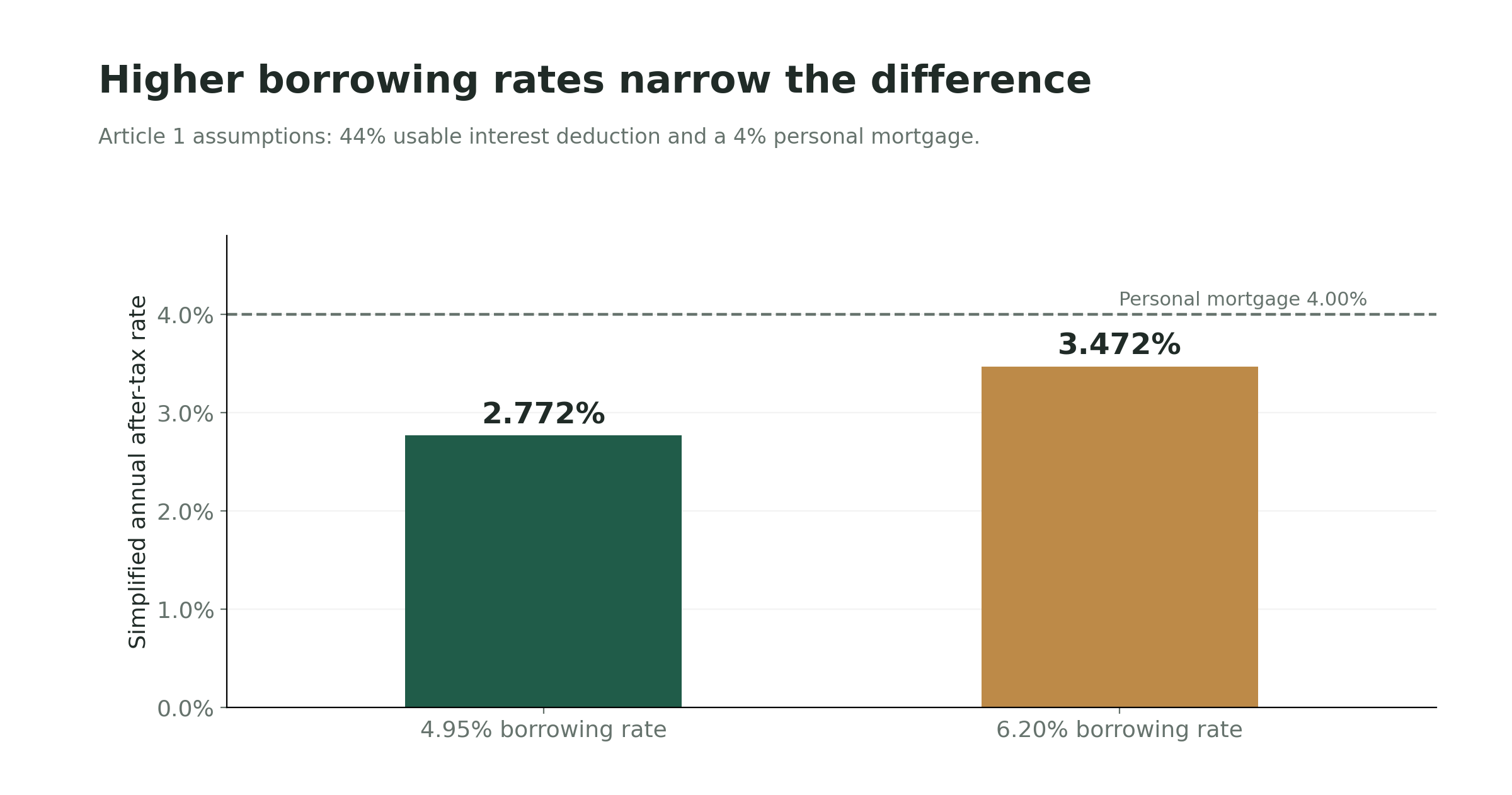
Figure 2. A higher borrowing rate reduces the potential cost advantage in the sole proprietor example.
There is still a positive difference under those particular assumptions, but there is less room for fees or a weaker tax benefit. A further rate increase could remove it.
FCAC notes that HELOC rates are usually variable, so a workable starting comparison needs a higher-rate test as well.
What an illustrative mortgage model projects
For an illustration starting with a 25-year mortgage baseline, the calculator results are:
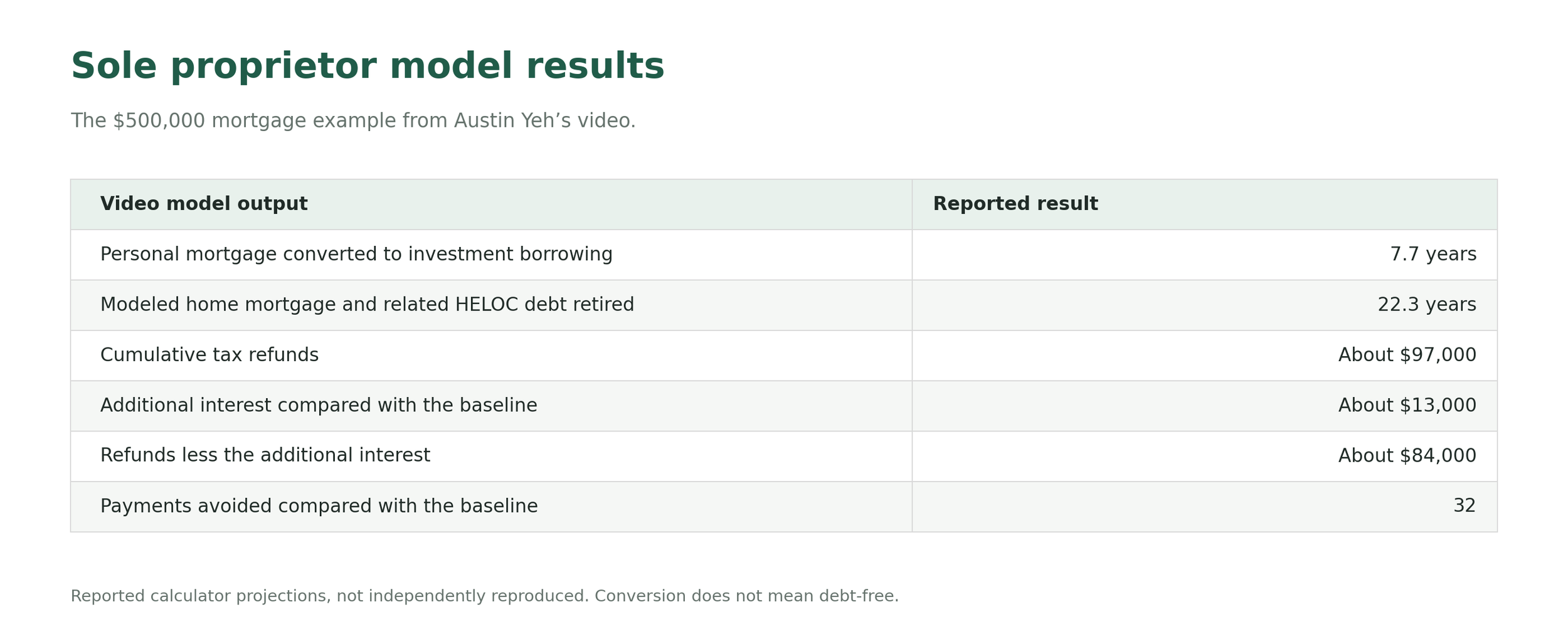
These are illustrative calculator projections.
The distinction between 7.7 years and 22.3 years matters. At the conversion point, personal mortgage debt has moved into another borrowing category. The related loan still needs to be repaid. The later date is the model’s debt retirement point.
Also, do not add every favourable number in the table together. Refunds used to accelerate repayments are already helping produce the earlier payoff. Counting the refund again as separate wealth can count the same benefit twice.
What I would check before starting
First, confirm how much cash the business can commit consistently. Revenue is not the same as spendable surplus. Tax instalments, sales tax, payroll obligations, and a slow month still need funding.
Next, check the mortgage’s prepayment privileges and the credit actually available after each payment. Readvancing is subject to the product and lending limits. It should never be assumed from a property’s headline equity alone.
Finally, ask for a combined debt schedule. I would want to see the personal mortgage, business borrowing, interest costs, tax assumptions, and repayment plan together. A faster fall in one account is only part of the picture.
If your immediate question is mortgage qualification, I’ll publish a seperate article on self-employed mortgages in Toronto addresses that separate issue.
COMMON QUESTIONS
Do I need that much profit every month?
The example uses $5,000 of receipts paired with $5,000 of suitable business payments. It does not establish a minimum profit requirement.
Your workable amount depends on available receipts, obligations, eligible payments, and approved credit.
Can I deduct the mortgage payment itself?
Cash damming does not turn your personal mortgage payment into a business expense. The potential interest deduction relates to qualifying borrowing used for the business.
What should I ask for in a personalized illustration?
Ask for the total debt balance over time, the cash required from you, the effect of higher rates, and the result if refunds are smaller or arrive later.
The strategy should fit your business’s actual cash cycle.
⚠️ Do Not Attempt Cash Damming Without Professional Guidance
Cash damming involves mortgage structuring, tax deductibility, leverage risk, CRA tracing requirements, and ongoing bookkeeping discipline. Mistakes in execution can invalidate deductions, create CRA reassessment exposure, increase financial stress, and compromise long-term strategy performance. Before implementing cash damming, speak with a qualified mortgage professional, an accountant experienced with CRA tracing requirements, and a tax advisor familiar with leveraged deductibility strategies.
Austin Yeh is a Smith Manoeuvre Certified Professional and independent mortgage agent based in Toronto, funding mortgages across Canada. He specializes in advanced mortgage strategies for high-income earners, real estate investors, and self-employed borrowers.
Lender features and policies are subject to change. Always verify current product details directly with the lender or through an SMCP-certified mortgage broker. This article is for educational purposes and does not constitute financial or mortgage advice.