
Most articles on cash damming explain the strategy.
This one explains which lenders you can actually use.
That distinction matters more than most people realize. Cash damming requires a very specific mortgage structure to work correctly. Get the lender wrong and the strategy either becomes impossible to execute, or you end up with a compliance problem you won't discover until CRA comes asking.
Here is what to look for and which products hold up.
Why the Lender Choice Is Not Optional
1. Re-advancement that keeps pace with your prepayments
Each dollar you prepay on the mortgage needs to reappear as room on the HELOC, or the cycle stalls. Most lenders re-advance 100% of principal only when your borrowing started below 65% of your home's value. Between 65% and 80%, most re-advance a reduced amount. Some also release room in steps rather than dollar for dollar: $100 increments at Scotiabank and $1,000 increments at RBC.
2. Monthly prepayments that don't hit the annual cap
Cash damming means a prepayment every month. Fixed-rate mortgage components typically allow 10% to 20% of the original balance a year. Rent of $2,800 a month is $33,600 a year. On a $300,000 fixed segment with a 10% limit, you'd hit the cap in under a year. Some lenders also limit how often you can prepay, not just how much. Where lump sums are restricted, increasing your regular payment can be a workaround (more on that under RBC).
3. A way to keep rental borrowing separate from personal borrowing
This is the one most investors misunderstand. CRA doesn't need you to tell your property tax draw apart from your insurance draw. Both are rental expenses, and both are deductible. The problem is mixing personal and rental borrowing on the same line of credit.
CRA's position, in Income Tax Folio S3-F6-C1 at ¶1.43, is that when one line of credit is used for both eligible and ineligible purposes, any principal repayment reduces both portions proportionally. Pay down a mixed line and you shrink your deductible balance along with your personal one. Over a decade of cash damming, that erodes the very deduction you built.
In practice, you need one of these:
A separate HELOC segment or tracking sub-account used only for rental borrowing, or
A single HELOC with no personal balance on it, used only for one rental from day one.
One related issue: where the lender charges the HELOC interest. If the interest is automatically debited from your personal chequing account, you're paying deductible interest with personal money every month. That can be fixed with a manual transfer each month, but it's friction, and friction is how setups break. Lenders that capitalize interest on the line, or let you pay it from the rental expense account, are cleaner.
The Lenders That Work
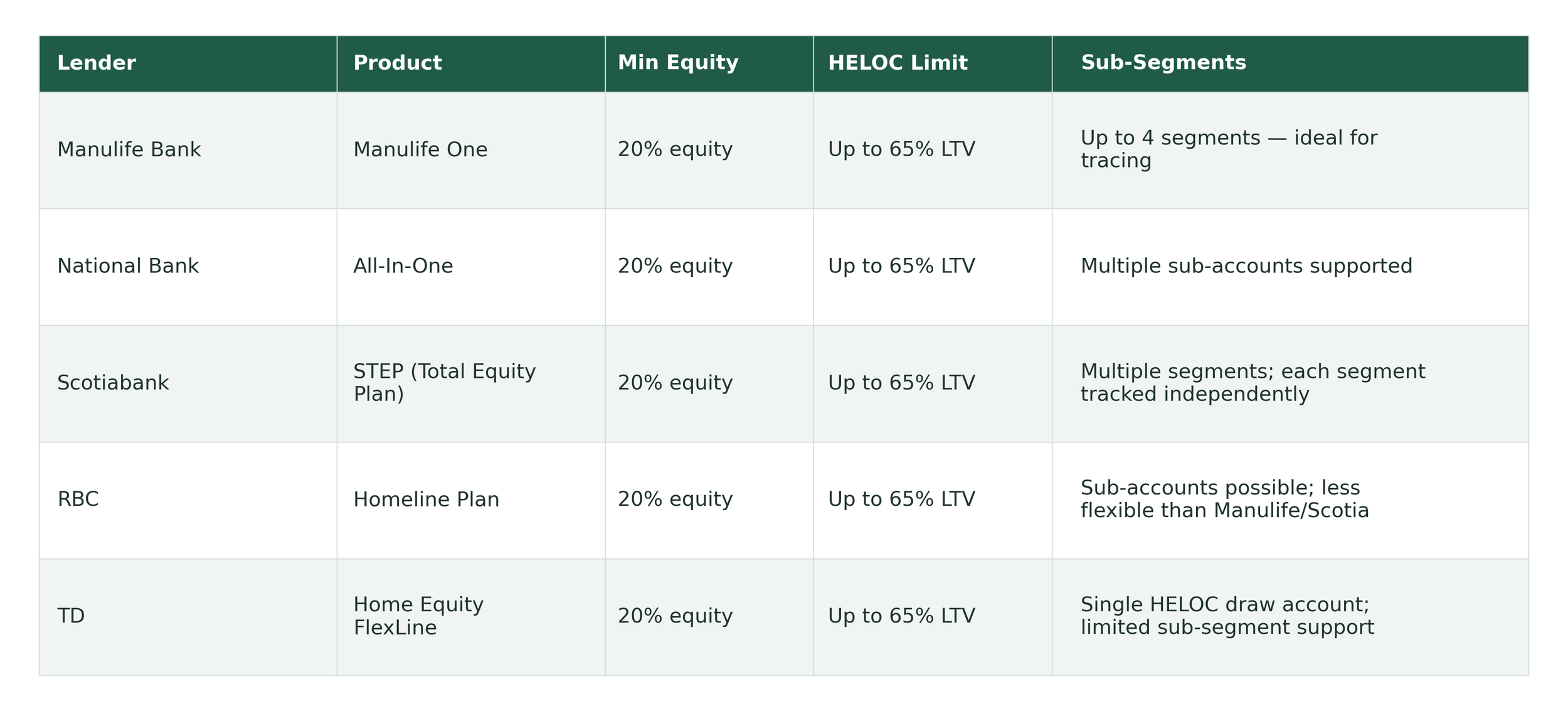
Manulife One
Manulife One is the most cash damming-friendly product in our survey, for two reasons the others can't match.
First, it capitalizes interest automatically. No other lender in our survey does. With the right setup, the interest on your rental borrowing stays on the deductible side instead of quietly landing on your personal balance.
Second, it gives you up to 15 tracking sub-accounts and 5 fixed rate sub-accounts. You can isolate rental borrowing for each property in its own sub-account, each with its own statement. When CRA asks for tracing records, the trail is clean by design.
It also combines your chequing, savings and mortgage in one account, so every deposit reduces the balance you pay interest on that day. The main account is open, so rent deposited there isn't limited by an annual prepayment cap. Fixed-rate sub-accounts still carry the usual 20% limit.
The HELOC rate typically runs around prime plus 0.50%. For cash damming, structure matters more than that rate, which we'll come back to.
Scotiabank STEP (Scotia Total Equity Plan)
STEP is widely used by investors, and it works well for a single rental. You can hold up to three HELOC segments and up to three mortgage components, including fixed-rate pieces alongside the variable line.
The catch for multi-property investors: only one of the three HELOC segments re-advances. Two rentals can't each have their own re-advancing segment. Scotia's prepayments do have one advantage: 100% of a prepayment becomes available on the HELOC, even when your borrowing is above 65% of the home's value.
Confirm two things up front. The automatic limit increase must be requested, and it requires title insurance paid by the borrower. Prepayment privileges are 15% a year as standard (20% on request), and they reset on your mortgage anniversary, not January 1.
National Bank All-In-One
National Bank's All-In-One has strong architecture: up to 99 HELOC components after funding (four at setup), and the line can be used as a transactional account. On structure alone, it rivals Manulife One.
The problem is the prepayment limit. At 10% a year, it's the lowest in our survey. On a $400,000 fixed component, that's $40,000 a year, about 14 months of $2,800 rent. National Bank does allow regular payments to increase by up to 100% of the original payment, which can absorb part of the gap. Also budget for the $7 monthly fee per HELOC segment.
Lenders That Generally Do Not Work for Cash Damming
BMO
On paper, BMO looks strong: up to 15 components, and 20% lump-sum prepayments at any time rather than once a year. The caveat is that many BMO mortgage products allow only one prepayment a year. Confirm the specific product before you commit.
TD and MCAP Fusion
Both re-advance properly, but each allows only one HELOC component. That works if the line is used only for one rental from day one, with no personal balance on it. If you already have personal borrowing on the HELOC, or plan to run more than one rental, a single line runs into the ¶1.43 problem above. MCAP also moves HELOC funds through its servicing team or portal, to one linked bank account, which slows the monthly cycle. Also note, TD Bank does not re-advance pre-payments $1 for $1 above 65% LTV.
RBC Homeline Plan: the double-up workaround
RBC allows up to five HELOC segments. The bigger issue is prepayments: RBC allows one lump-sum prepayment a year, up to 10%. That rules out the usual monthly rent prepayment.
The workaround is RBC's double-up option. Instead of a monthly lump sum, you increase your regular mortgage payment, up to double the original amount, by roughly the rent. The extra principal re-advances to the HELOC each month, and you borrow from there for rental expenses. However, it still may not be a viable solution for most people.
Also note, RBC does not re-advance pre-payments $1 for $1 above 65% LTV.
Lenders that generally don't work for cash damming
CIBC and Desjardins: one HELOC component, and the HELOC interest is charged to your personal account. You'd be fixing the interest by hand every month on a line you can't segment. In Quebec, Desjardins also doesn't offer a HELOC until your borrowing is below 65% of the home's value.
CMLS: the line of credit isn't re-advanceable. The limit set at approval stays fixed, so prepayments never create new room.
B-lenders: these products are built to get you qualified, not for long-term structure. If you're with a B-lender for qualification reasons, cash damming usually waits until you can move to an A-lender with the right product.
The Minimum Equity Requirement
Whatever the lender, you need more than 20% equity in your home to set up a readvanceable structure. Under federal lending guidelines, the revolving HELOC portion is capped at 65% of the home's appraised value, and the mortgage and HELOC together are capped at 80%.
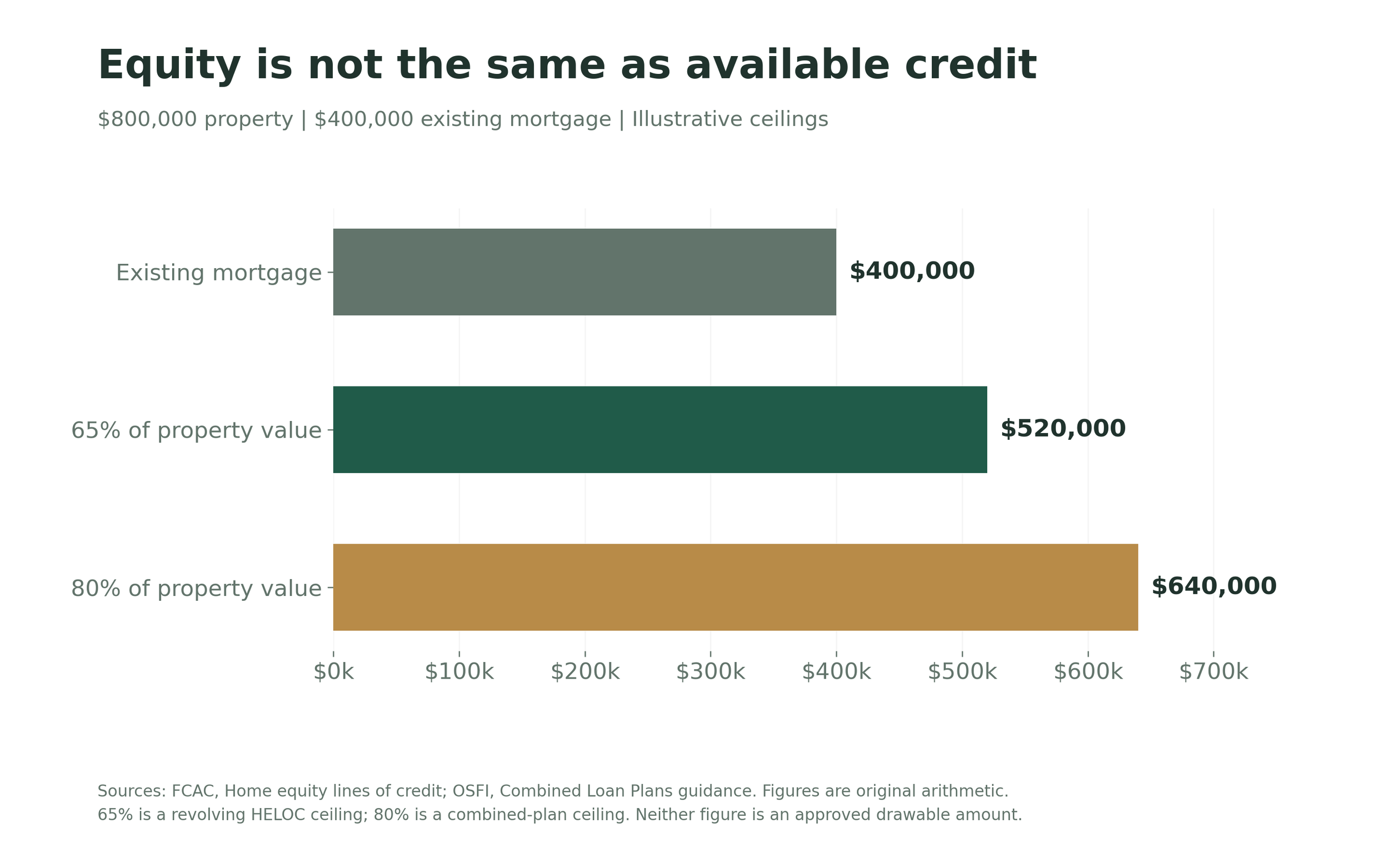
Example: $800,000 property with $400,000 remaining mortgage. The HELOC maximum is $240,000 (65% of $800K minus the $400K mortgage). As you prepay the mortgage, the available HELOC room grows, which is the mechanism behind the strategy.
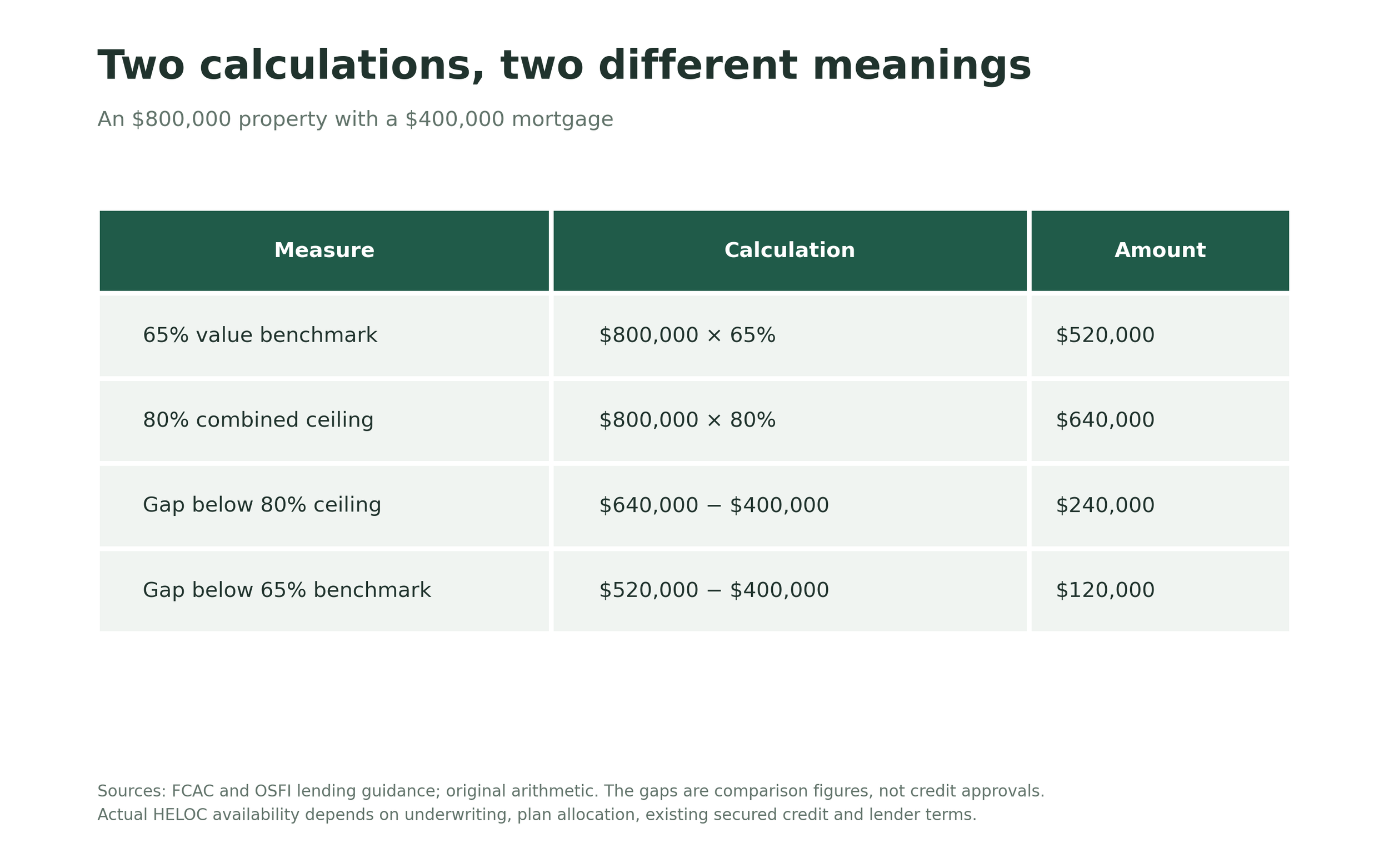
These figures illustrate the lending ceilings, not approved borrowing room. Ask the lender to confirm how much is actually available to draw.
If your equity is below 20%, cash damming is not available yet. The path is to continue paying down the mortgage until you cross the threshold, then set up the right product.
What to Ask Your Mortgage Professional Before Setting Up
Before committing to a lender or product, confirm the following directly:
Can I make a prepayment every month, and how much per year? Does the limit reset on January 1 or on my mortgage anniversary?
If lump sums are restricted, can I increase my regular payment instead, and can I lower it again later?
Does HELOC room re-advance automatically when I prepay, at what percentage, and in what increments?
How many HELOC segments or sub-accounts can I have, and how many of them re-advance?
Where is HELOC interest charged: to the line itself, or to my personal account? Can I change that?
Is there a monthly fee for the plan or per segment?
If the answer to any of these is unclear or negative, you may be looking at the wrong product.
Just as important is who sets it up. Work with a licensed mortgage professional who has implemented cash damming before, ideally one with Smith Manoeuvre certification (such as myself), alongside an accountant familiar with interest deductibility. Most of the costly mistakes happen at setup, and a lender's branch staff usually won't know how to structure the accounts for CRA tracing.
Structure Beats Rate. Every Time.
I have seen investors choose a lender based on a rate that was 0.15% lower, then spend two years trying to execute cash damming on a product that was never built for it. The documentation is a mess, the tracing is unclear, and the deduction is at risk.
The right product makes the strategy clean to execute, easy to document, and defensible if CRA ever asks. That is worth far more than a rate difference that amounts to a few hundred dollars a year.
Get the structure right first. The rate conversation comes after.
Not sure which product fits your rental structure? Book a free assessment with Austin Yeh. I'll review your current mortgage, equity position, and whether cash damming is set up to work correctly.
Disclaimer
This article is for educational purposes only. Nothing here constitutes tax, legal, financial, or mortgage advice. Lender products and terms change. Always confirm current product details directly with the lender. Speak with a qualified mortgage professional and accountant before implementing cash damming.