Two Real Estate Markets - Opposite Futures

Everyone is watching prices right now. Honestly, it's not a pretty picture. But I want to talk about what's coming after.
The Canadian housing market is actually two completely different stories depending on whether you're looking at ownership or rentals — and they're heading in opposite directions.
Let's start with ownership.
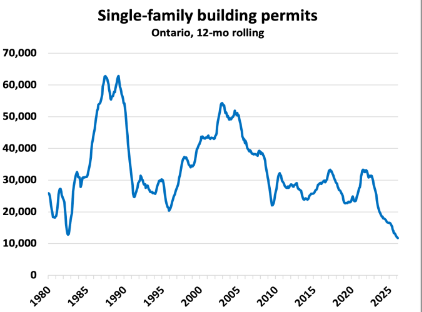
Single-family housing completions just hit their lowest level in 30 years nationally. In Ontario, it was the worst quarterly reading since 1991. Single-family building permits in Ontario have hit 40-year lows. That matters because every completion starts with a permit — and this downward trend is setting up a meaningful supply shortage for this asset class down the road.
I've mentioned this before, but couple that with investors purchasing single-family homes and converting them into 5 and 6-plexes — you're taking an already scarce resource and making it even scarcer.
Developers aren't launching new projects into a slow market. You can't blame them. But the consequence is a supply pipeline that is structurally shrinking at exactly the moment when buyer demand sits at generational lows.
Which brings me to demand.
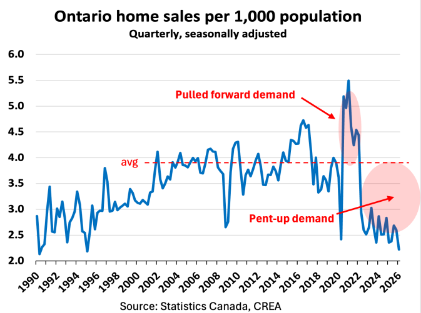
Ontario home sales per capita just hit a 30-year low. Most people read that as bearish. I'd argue the coil is just winding tighter.
Things don't stay this depressed forever. History tells us demand reverts back to the mean — not to the frenzy of 2021 and 2022, but back toward normal. The timeline is the one thing nobody can tell you with certainty. What I can tell you is that the longer it stays pent-up, the more demand builds on the sideline. And when it does move, it will meet a supply picture that looks nothing like today's.
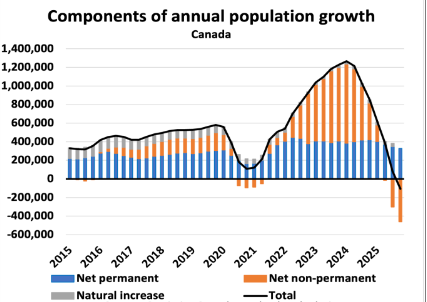
Canada's permanent resident population (the blue line on the chart above) are the people who eventually become homeowners — is still growing at roughly 350,000 per year.
The non-permanent residents (orange line) leaving the country were primarily renters, not buyers. That distinction matters.
Permanent residents rent for a while, they wait, and at some point they buy. The longer sales stay this depressed, the more latent demand builds up. And when something finally shifts — rates, confidence, policy — it will meet a supply picture that looks nothing like today's.
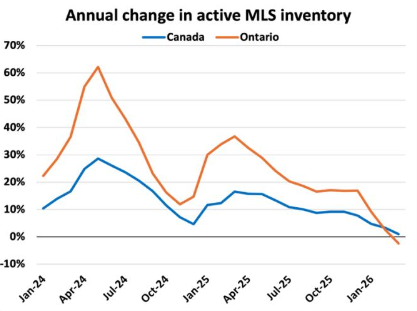
Active inventory in Ontario is already down 10% from its peak, despite the weakest sales environment in decades. New listings are declining. The market isn't flooding. It's quietly tightening while buyers sit on the sidelines.
Now flip to rentals, and the picture is the exact opposite.
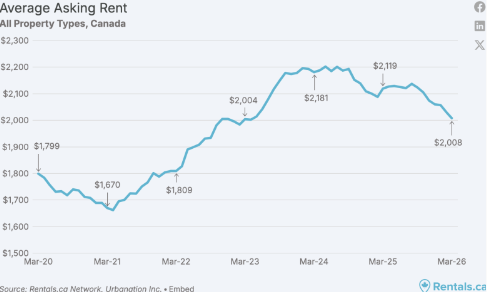
Average asking rent in Canada just fell to a 35-month low of $2,008, down 5.3% year-over-year. New lease rates have turned negative nationally for the first time.
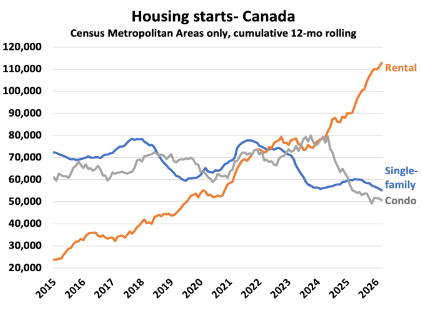
And the full wave of supply hasn't even arrived yet. There are over 110,000 rental unit starts, and it makes up almost 60% of all housing starts the past 12 months.
There are 204,000 rental units still under construction across the country, equivalent to roughly 8.2% of the entire existing rental stock. That supply is coming regardless of what demand does.
The other factor is non-permanent residents. International students and temporary workers — historically the backbone of rental demand — are arriving at 76% below 2024 levels. The rental market was already softening before this. Now you have more supply hitting at the same time as demand falls away.
So here's where I land.
If you're renting, you have more leverage than you've had in years — and that's not changing anytime soon. But that same environment also creates one of the more compelling ownership windows Ontario has seen in a long time.
Prices may still grind lower. But I believe we're closer to the bottom than most think.
If you're an owner, the medium-term supply picture is working in your favour even if it doesn't feel that way today.
And if you're a buyer sitting on the sidelines waiting for the perfect moment — just know that the supply pipeline feeding future resale inventory is the smallest it's been in four decades.
If you want to run through what this means for your situation specifically, just reply to this email or click below to book a call.
Austin Yeh is a Smith Manoeuvre Certified Professional and independent mortgage agent based in Toronto, funding mortgages across Canada. He specializes in advanced mortgage strategies for high-income earners, real estate investors, and self-employed borrowers.
Lender features and policies are subject to change. Always verify current product details directly with the lender or through an SMCP-certified mortgage broker. This article is for educational purposes and does not constitute financial or mortgage advice.